The house sits on Lake Rabun, in the north Georgia mountains. The roof planes meet over a courtyard, crossing each other at angles no standard detail covers. Every seam on that roof had to run true — straight, even, unbroken — straight through each transition where one plane hands off to the next.
That's the job. This is how it got done.
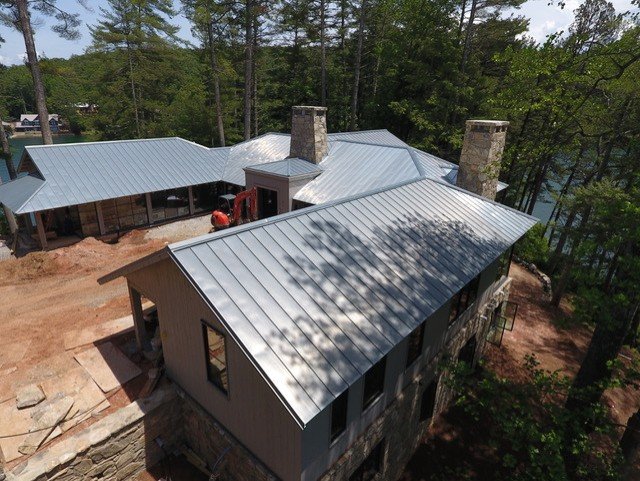
The material: VM Zinc
Zinc doesn't behave like the metals most roofers know. It goes on bright and settles, over its first seasons, to a soft matte gray. Against the trees and the water at Lake Rabun, it sits easy — no glare, no shine asking for attention.
It also lasts. Zinc is a roof you install once and hand to the next owner.
The seam: double-lock, by hand
The panels on this roof are joined with a double-lock standing seam. The technique is hundreds of years old. Each panel edge is folded together twice, by hand — no exposed fasteners, nothing to snap loose, nothing to back out in twenty years and start a leak.
Almost nobody sews a roof this way anymore. It takes longer. It takes installers who learned it as a craft, not a shortcut. We are the only installer in the Southeast who still does it.
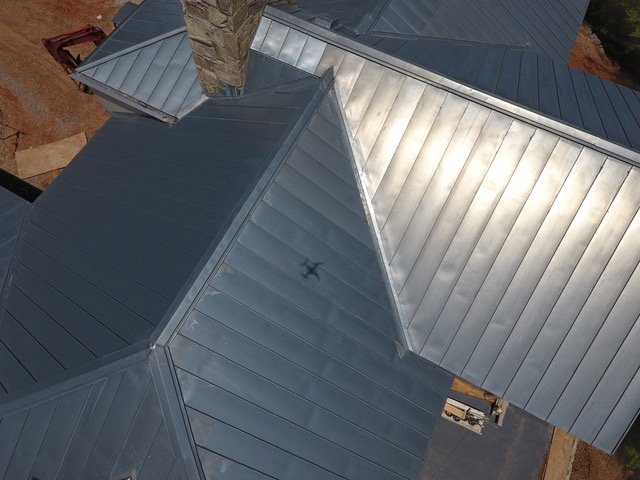
On a plain rectangle, a sloppy seam hides. Over that courtyard, with planes crossing, there was nowhere to hide. A seam that wanders shows from across the lake.
Photographed while it went on
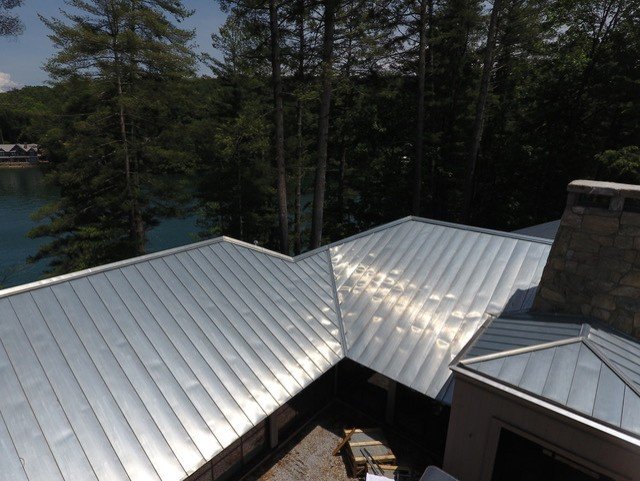
The photos with this story weren't taken at the end, with the yard cleaned up. They were taken during the work — panels going down, seams being folded, the courtyard transitions taking shape. That's the part of a roof nobody usually sees, and it's the part that decides whether the roof is still sound in fifty years.
— Gary Shank